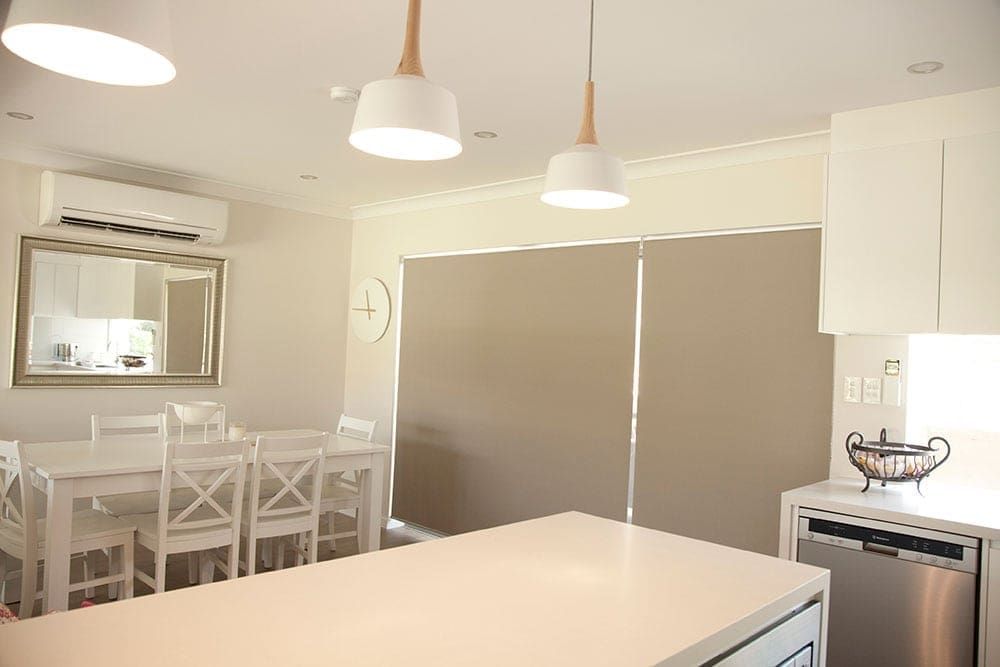
Roller blinds are the most common window furnishing in Australian homes and probably the least understood. The short answer is that the fabric is usually polyester or PVC-coated polyester, wrapped around an aluminium tube. But that barely matters compared to which type of fabric you choose, because that single decision determines whether the blind controls heat, gives you privacy at night, or darkens a room properly. It is the most common thing we correct in the showroom, particularly for the big street-facing windows in newer Macarthur homes. Here is what is actually inside a roller blind and how to choose the right one.
Fabric Is the First Decision
Roller blind fabric is grouped by how much light passes through it, and this choice determines what the blind can and cannot do for you.
Sunscreen
An open-weave fabric that blocks UV and glare while you can still see out. Rated by openness factor, usually between 1% and 10%. A lower number means a tighter weave, more heat rejection and less view. Sunscreen gives you daytime privacy but almost none at night, because once the room is lit and it is dark outside, the effect reverses. This is the single most common surprise for people who fit sunscreen in a street-facing bedroom.
Translucent
Also called light filtering. A closed weave that softens light across the whole room without letting you see through it. Full privacy day and night, but no view and no real heat control. Common in bathrooms and hallways.
Blockout
A fabric with an opaque backing that stops light passing through the material entirely. The right choice for bedrooms, media rooms and anywhere you sleep during daylight. Worth understanding that blockout fabric does not equal a blackout room on its own, which we cover below.
Double Roller
Two blinds on one bracket, usually sunscreen at the back and blockout at the front. You get view and glare control by day, full privacy and darkness at night. It costs more than a single blind but less than fitting blinds and curtains, and it is the most popular configuration we install in new homes.
How Roller Blinds Open and Close
The mechanism is the second half of the decision and the part you notice daily.
Chain Driven
A continuous loop chain turns the tube. Simple, reliable, and the cheapest to make. In Australia the chain must be fitted with a tensioning device anchored to the wall or frame, which is a mandatory safety requirement in homes with young children. If your existing blinds have a loose hanging chain, that is worth fixing regardless of anything else.
Cordless and Spring Loaded
No chain at all. A spring mechanism inside the tube is tensioned during manufacture, and you raise or lower the blind by hand at the bottom bar. Pull down slightly and release, and the spring retracts it. Cleanest look, safest option around children, and the reason many people ask for it. The trade-off is that they are harder to fine-tune to a precise mid-height, and the spring is calibrated to the specific blind, so they cannot be shortened later.
Motorised
A motor inside the tube, operated by remote, wall switch, app or schedule. Battery motors need no wiring and recharge a couple of times a year. Hardwired motors never need charging. Practical anywhere the blind is out of reach, and increasingly standard on high windows and stairwell voids.
Getting a Truly Dark Room
Blockout fabric stops light through the fabric, but light still enters around the edges of the blind. In a bedroom this shows as a bright outline on the wall.
The fix is a fully cassetted blind: a cassette enclosing the roll at the top, side channels down each edge, and a bottom bar that seats into the sill. Together these close the gaps the fabric cannot. If genuine darkness matters, ask for the cassette and channels specifically, because a standard blockout blind on face-fit brackets will not get you there. For a full comparison of the options, see what blinds block out the most light.
Frequently Asked Questions
What does openness factor mean?
It is the percentage of open space in a sunscreen weave. A 1% fabric is tight, blocks the most heat and glare, and gives the least view. A 10% fabric is open, gives a clearer view and lets more heat through.
Can you see through sunscreen blinds at night?
Yes, from outside in, once interior lights are on. Use double rollers or a blockout fabric where night privacy matters.
How do cordless roller blinds work?
A pre-tensioned spring inside the tube counterbalances the blind’s weight. A short downward pull releases the brake and the spring retracts it.
Are roller blinds suitable for bathrooms?
Yes, in 100% polyester or PVC-coated fabrics, which resist mould better than natural fibres. There is more on this in our guide to the best window coverings for wet areas.
Are roller blinds a good option for sliding doors?
They can be, though panel blinds and vertical sheers often suit wide openings better.
How do you clean roller blinds?
Vacuum with a soft brush attachment and spot clean only. Full details in our guide on how to clean blinds.
Choosing between fabrics is much easier with a sample in your hand and the light of your own room behind it. Browse our roller blinds range, visit our Smeaton Grange showroom, or contact us for a free measure and quote.